 FlowSentric
Why your business shouldn't lock into one AI model (and how EU-hosted models work)
Model quality, price and availability change every few months. A multi-model workspace lets you switch per task, compare side by side and pick where a request runs.
- The best model for a task changes every few months. Pick per task, not per company.
- Model Compare runs one prompt against up to five models; agent evaluations show whether a model swap helps or hurts.
- Every model carries a region label. 26 EU-hosted models and 12 local ones ship out of the box.
Eighteen months ago the best model for drafting German correspondence, the cheapest one for classification and the fastest one for summaries came from three different companies. The ranking has flipped several times since, and it will flip again before this post is old. If your AI setup is built around one vendor, every one of those flips is either a migration project or an improvement you quietly miss.
We built FlowSentric around that assumption. Not because any single provider is bad, but because betting a business on one of them in 2026 is a strange thing to do.
What multi-model means here
FlowSentric ships with 18 chat providers and 118+ models in the default catalog: OpenAI, Anthropic, Google Gemini, Mistral, DeepSeek, Groq, xAI, Perplexity, Cohere, Together, OpenRouter, Qwen, Moonshot, Zhipu, MiniMax, Z.ai, locally hosted models and an EU gateway. Adding a provider is configuration, not a code change, and admins can edit the catalog while the system runs.
You don't have to think about any of that day to day. In chat you pick a model per conversation. In an agent, a model per agent. In a workflow you can mix: a cheap model for triage, a strong one for the final draft. That last pattern is where most of the savings hide.
Compare before you commit
Model Compare runs the same prompt against two to five models side by side. It's the quickest way we know to settle "which model writes better German?" with evidence instead of opinions in a meeting. Agents go a step further: their evaluation suite runs a set of test cases against an agent and scores the output with an LLM-as-judge rubric, so you can swap the model and watch the pass rate move.
Where a request is processed
Every model in the catalog carries a hosting region: EU, US or local. The picker groups by region with a flag and lets you filter to EU-hosted or local only.
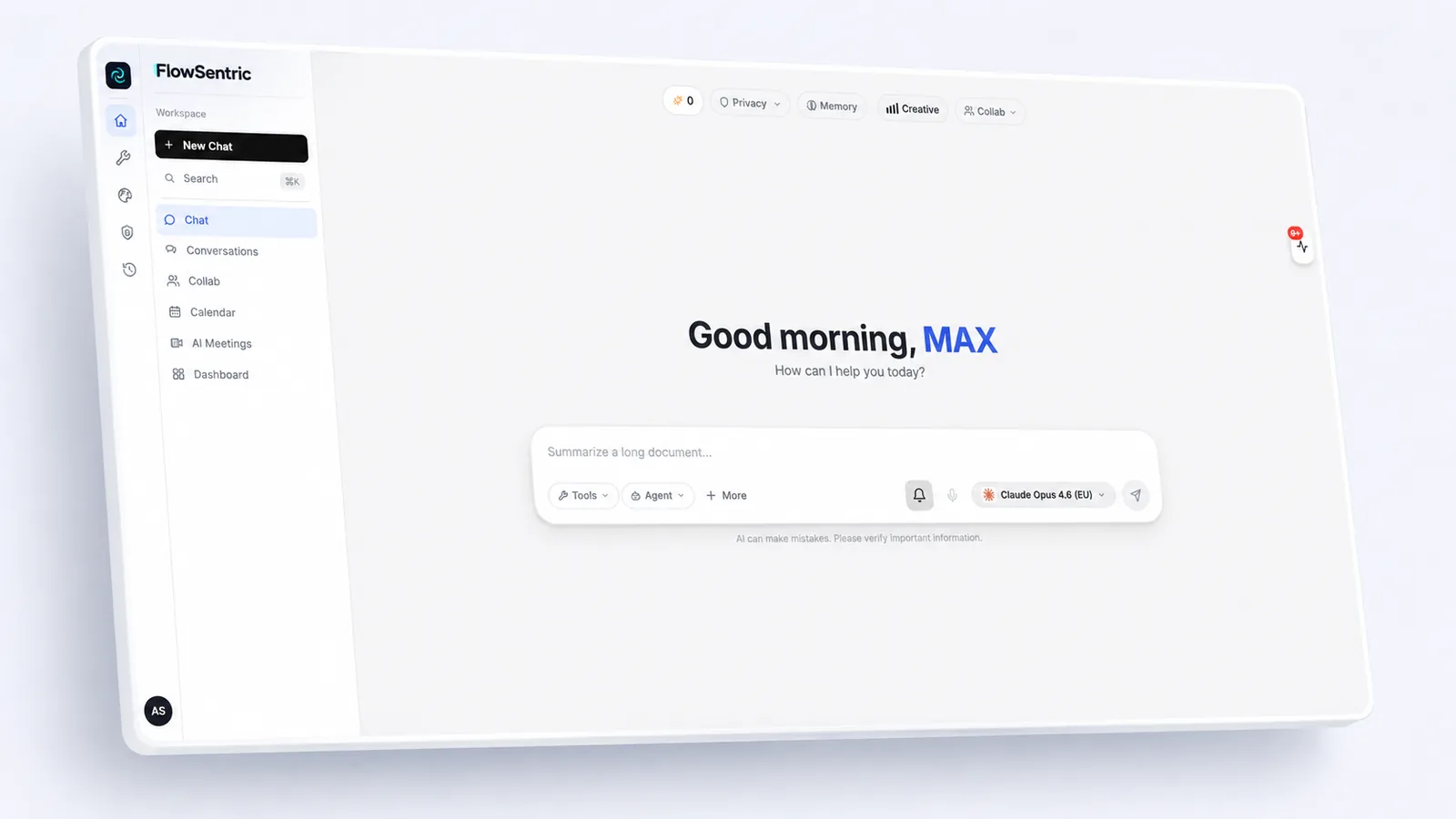
- EU-hosted models are routed through an EU gateway and their names end in "(EU)": "Claude Opus 4.6 (EU)", "GPT-5 (EU)". Requests go to the gateway's EU endpoint, never to the US API. There are 26 of them out of the box, available with the Business and Custom packages.
- Local models run on our own GPU servers, or on yours. The catalog ships 12 of them. For embeddings and PII detection, local is the default.
- US-hosted models are the direct provider APIs. Transfers rely on Standard Contractual Clauses or an adequacy decision, and Privacy Guard can mask personal data before the request leaves.
Bring your own keys and models
With a Custom package you can bring your own provider keys and register your own models, say a fine-tuned model behind your own API endpoint, and pin embeddings, vision and transcription to your own hardware.
The full list lives on the AI Chat page. Or compare a few models yourself on the Free plan; it takes about two minutes.